Jasmine Andrade
[ad_1]
The positive aspects of the landmark compact-company reduction method developed at the top of the pandemic primarily went to business entrepreneurs fairly than workers, a study from top economists finds.
The analyze from authors which includes famed Massachusetts Institute of Technologies economics professor David Autor, as perfectly as a number of Federal Reserve economists, examined the $800 billion Paycheck Defense Application. It was circulated by the National Bureau of Financial Research, and tapped into knowledge from payrolls processor ADP.
The PPP originally was signed into regulation by President Donald Trump in April 2020, and President Joe Biden signed an extension in March 2021. Both the first regulation and the extension were overwhelmingly bipartisan.
The significantly-reaching PPP finished up sending loans to somewhere around 93% of tiny enterprises, in just two months. The finish outcome, the authors estimate, is that the plan preserved up to 3 million “job years” of work at a price tag of among $170,000 to $257,000 per career-year retained.
Set an additional way, involving 23% to 34% of PPP pounds went right to employees who normally would have missing jobs, the research found. The application also was hugely regressive, with a few-quarters of PPP resources accruing to the top quintile of homes.
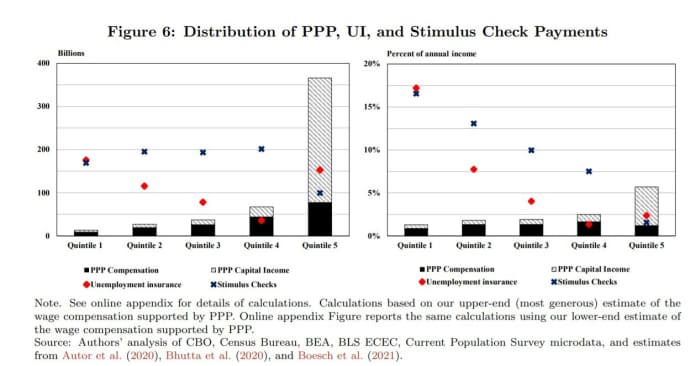
The authors explained PPP did assist retain the lights on at establishments that usually would have shut, though they don’t know regardless of whether that was a lasting or temporary impression. PPP financial loans served decrease employment losses because of to tiny-company closures by about 8 share details five weeks following loans were obtained, the authors stated.
An additional obtaining was that so-identified as second-attract loans in 2021 — that is, providers likely back for a lot more funding a 12 months later on — experienced no effects on work. The authors mentioned that was…
[ad_2]
Read much more below